7th All Bengal Chess Championship 2026 -Organized by BIRATI CHESS ACADEMY (MSME-Govt.of India Registered Academy).

Registration Open
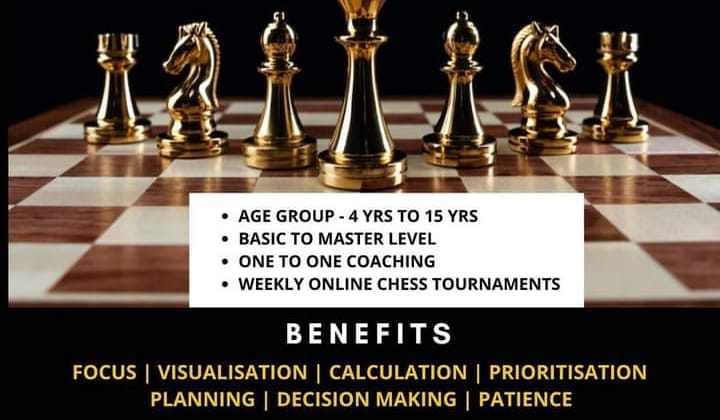
7th All Bengal Chess Championship 2026 -Organized by BIRATI CHESS ACADEMY (MSME-Govt.of India Registered Academy).

Birati Chess Academy – Online & In-Centre Chess Training with AI Technology

Birati Chess Academy offers professional chess coaching for children and adults through online and in-centre classes. Equipped with AC classrooms, digital smart boards, and AI-powered chess training, the academy provides a modern learning environment under the guidance of International Title Awardee Kunal Sir. Whether you are a beginner or an advanced player, our structured training programs help develop strategic thinking, concentration, and competitive success.
#ChessAcademyIndia #OnlineChessClasses #ChessTraining #ChessForKids #ChessCoaching #ArtificialIntelligence #AIChess #ChessAcademy #ChessEducation #ChessTournament #ChessChampion #KunalSir #BiratiChessAcademy #FITIndia #MindSports #StrategicThinking #ChessLearning #KolkataChess #WestBengalChess #WeMakeChampions
Birati Chess Academy, Best chess academy in Kolkata, Online chess classes India, Kunal Sir chess coach, Chess training with AI, Fit India approved chess school, In-centre chess coaching Kolkata, Learn chess from international title awardee
Chess Tournament preparation pre-game and post-game routines by International -FIDE Title Awardee KUNAL SIR
Tournament
preparation is a structured process designed to maximize your mental sharpness
and minimize fatigue. It involves consistent tactical drills, physical rest,
and familiarization with the tournament playing environment.

Pre-Game
Routine (Days Leading Up to the Event)
Pre-Game
Routine (Day of the Game)
Post-Game
Routine
Sportsmanship training
Chess
sportsmanship training involves building emotional resilience, adhering
strictly to touch-move rules, and mastering the physical etiquette of
over-the-board play. It teaches players to accept both wins and losses
gracefully, manage tournament pressure, and respect their opponents before,
during, and after the match.
Key
Components of Chess Sportsmanship
Teaching and
practicing good sportsmanship build essential character traits and prevents
common tournament penalties.
1.
Pre-Game Etiquette
2. During
the Game
3.
Post-Game Protocols
How to
Train Sportsmanship
Good
sportsmanship can be developed through a combination of structured practice and
emotional control training.
Thank
You
BIRATI
CHESS ACADEMY
Why Birati Chess Academy is the No.1 Choice for Young Chess Aspirants
In today's fast-paced digital world, chess serves as one of the finest tools to sharpen a child's focus, patience, and analytical thinking. However, raw talent requires structured guidance to transform into a championship-winning performance. This is where Birati Chess Academy excels.

Spearheaded by International Title Awardee and StateArbiter Kunal Sir, our academy has earned its reputation as the premier training ground for young minds in Kolkata and across the globe via our virtual classrooms.
Next-Gen AI Lessons: We stay ahead of the curve by integrating Artificial Intelligence (AI) into our curriculum, offering the most advanced modern chess lessons available.
Smart Infrastructure: Our training center is built with a modern design, boasting full air-conditioning and interactive Digital Smart Boards to make complex tactics visually engaging.
Elite Tournament Preparation: We don't just teach the rules; we build competitors. Our targeted curriculum prepares kids to face high-pressure state, national, and international tournaments with confidence.
Uncompromised Security: We provide peace of mind to parents with professional-grade CCTV monitoring safeguarding the entire facility.
Whether you prefer the immersive experience of our In-Centre classes or the convenience of our Online interactive sessions, we have the perfect fit for your family's schedule.
Invest in your child’s cognitive future today. Admissions for our new batches are currently live!
Get in Touch:
📞 Call / WhatsApp: +91-9836614608
📢 Admission Open – Limited Seats Available!
#ChessCoachingKolkata #BiratiChessAcademy #BestChessAcademy #LearnChessOnline #ChessWithAI #KunalSirChess #KidsChessChampion #KolkataBlogs
Wishing all our brilliant students the very best of luck! ♟️✨

The Chess Online Tournament International (4th Edition) is finally here. Stay focused, give your best move, and play like a champion. We are incredibly proud of each and every one of you! Let the digital battles begin. 🏆
Organised by: Birati Chess Academy
📞 For any queries, Call or WhatsApp: +91-9836614608
#BiratiChessAcademy #ChessOnlineTournament #4thEdition #ChessChampions #Checkmate #ChessKids #FutureGrandmasters #MindGames #OnlineChess #PlayChess
♟️ Become a Certified Chess Coach with Birati Chess Academy! ♟️

Are you passionate about chess and looking to inspire the next generation of players? Turn your passion into a rewarding career with our upcoming Teachers Training Course!
Birati Chess Academy is proud to offer a comprehensive, expert-led training program designed specifically for aspiring chess educators and coaches.Limited Seats.
Course Details:
• Program: Chess Teachers Training Course
• Duration: 4 Months
• Format: 100% Online (Learn from the comfort of your home!)
Ready to make your move?
📞 Contact us today for admission details Phone Number / WhatsApp +91-9836614608
Google Admission Form : https://forms.gle/F8A2dnNFJyGYrX4V9
• #BiratiChessAcademy
• #ChessTeacherTraining
• #OnlineChessCourse
• #ChessCoachTraining
• #LearnToTeachChess
• #ChessCoaching
• #ChessAcademy
• #ChessEducator
• #TeachChess
• #ChessForKids
• #ChessSkill
How to Lesson Planning, Curriculum design, Student progress tracking in chess
by International Title Awardee Kunal
Sir.
Section
A: Overview of the Curriculum
This section delineates the main components of the
curriculum while providing a comprehensive overview of how Student Learning
Outcomes (SLOs) are distributed across grade levels.

Aims of the Chess Curriculum
The overarching aims of the chess curriculum are as follows:
● Impart fundamental chess skills and strategies for
practical application.
● Strengthen basic chess knowledge and critical thinking
abilities to build a solid foundation for advanced chess learning.
● Develop the ability to reason logically and analyze
diverse game situations.
● Foster a lasting understanding of chess principles through
hands-on practice, visual aid, and conceptual discussions.
● Engage in gameplay and puzzles to develop skills in chess
reasoning, information processing, making connections to real-life situations,
and making judgments.
● Foster an appreciation for chess and cultivate an
enjoyment of learning and playing the game.
This curriculum document includes details of pedagogical
approaches designed to aid chess educators in achieving the overall aims of
this curriculum. For example, among others, real-life scenarios and chess
puzzles are two strategies to achieve the aims of this curriculum. These
approaches engage students in analyzing game situations and applying chess
knowledge to solve related real-life problems. Moreover, students get
opportunities to construct similar game scenarios, enhancing their intellectual
engagement with chess content.
The curriculum emphasizes principles, patterns, and
strategic systems so that students can apply their evolving chess knowledge and
develop a comprehensive understanding of the subject. Further, it contains
assessment guidelines to ensure an effective alignment amongst learning
outcomes, instructional design, and assessment methods. Specific formative
assessment strategies are also suggested for the improvement of students'
learning. An effective learningoutcomes-oriented quality assurance system based
on constant monitoring and an effective feedback loop is recommended.
Chess textbooks and workbooks play a key role in providing
quality chess education at all levels. In addition to these, teaching and
learning resources include chess software, apps, online tutorials, chess clubs,
and a range of web-based and electronic resources. Suggested activities, web
links, and reference books are added to help the users of the chess curriculum.
Curriculum
Breakdown/ Outline
This section consists of the level wise breakdown of the
curriculum.
Unit 1: Introduction to Chess
What is Chess?
History of Chess.
Benefits of Playing Chess.
Movements of Chess Pieces.
Unit 2: The Chessboard
Squares on the Chessboard.
Types of lines on the Chessboard.
Chess Notations.
Unit 3: Chess Pieces
Types of Chess Pieces.
Movement and placement of Chess Pieces on the Board.
Mathematically Assigned Values to Chess Pieces.
Unit 4: Check, Checkmate, and Draws
Introduction to Check.
Introduction to Checkmate.
Draws in Chess.
Unit 5: Attack and Defense
Strategies for Attacking in Chess.
Defensive Techniques.
Unit 6: Special Moves
Castling.
En Passant.
Pawn Promotion.
Unit 7: King Under Threats
King Under Attack.
Basic Checkmate Patterns.
Draws and Stalemate.
Unit 8: Other Tactics Rules
Pin
Fork
Castling
Discovered Attack
Deflation
Skewers
Unit 9: Chess Opening, Middle game and End Game
Basic Opening Strategy Introduction to Openings in Chess
Middle game master
End Game calculation
Unit 10: Calculation and Analysis the chess game
Analyzing Variations and Positions.
Introduction to
Advanced Analysis Techniques.
Section
B: Teaching Chess
This section details the crucial components involved in the
effective teaching of chess.
Teaching Strategies
Teaching strategy for chess should be a combination of
theoretical lessons, interactive discussions, hands-on activities, and
practical gameplay. Considering this, the following strategies can be
implemented for teaching chess:
1. Demonstrations: The teacher should provide clear
demonstrations of chess concepts, moves, and strategies. Visual aid items such
as a demonstration board or digital resources can be used to enhance
understanding.
2. Interactive Discussions: Engage students in
interactive discussions to encourage critical thinking and problem solving. Ask
open-ended questions, encourage students to share their ideas, and facilitate
discussions on strategies and tactics.
3. Hands-on Activities: Incorporate hands-on
activities to reinforce learning. Use worksheets for drawing and coloring
chessboards, manipulatives for understanding piece movements, and puzzles to
develop critical thinking skills.
4. Practice Games: Organize practice games within the
classroom to provide students with opportunities to apply their knowledge and
improve their skills. Encourage fair play, provide guidance when needed, and
facilitate discussions on game analysis afterward.
5. Individual and Group Work: Assign individual or
group projects where students can research and present on specific topics
related to chess, such as famous players, historical games, or opening
variations. This promotes independent learning and fosters teamwork.
6. Differentiation: Recognize and accommodate the
varying skill levels and learning styles of students. Provide additional
challenges for advanced learners and offer extra support to students.
Student
progress tracking
Puzzle Pattern Accuracy: Instead of just tracking the
number of puzzles, log accuracy on specific tactical themes (e.g., pins, forks)
to ensure skill acquisition.
Opening Survival Rate: Monitor how often the student
reaches a playable middlegame (e.g., tally games where they are not completely
lost by move
Mistake Pattern Categorization: Track the types of
mistakes made (tactical, positional, or time management) to identify and
address weaknesses.
Time Management Check: Evaluate if the student is
playing too quickly (rushing) or too slowly (time trouble), which indicates
discipline in calculation.
Thank You
@BIRATI CHESS ACADEMY
BIRATI CHESS ACADEMY proudly presents the 25th Baisakh Rabindra Jayanti Celebration Contest to encourage creativity, confidence, and cultural expression among children worldwide. 🌍♟️
Participants can showcase their talent through:
✔ Dancing
✔ Singing
✔ Recitation
✔ Speech & More

📹 Submit a One Minute Video related to Rabindra Jayanti via WhatsApp.
🏆 Top Three Winners will receive Cadbury Celebrations.
🍫 Every participant will receive Cadbury Five Star chocolates.
🎉 Entry is FREE and open for participants from Worldwide.
📞 Call / WhatsApp: +91-9836614608
#BiratiChessAcademy #RabindraJayanti #RabindranathTagore #CulturalCompetition #KidsActivities #OnlineContest #CreativeLearning #TalentDevelopment #ChessAcademy #WorldwideContest #IndianCulture #StudentEngagement
Chess & Strategy: The Psychology
of Chess
By International Title Awardee KUNAL
SIR
The world of chess is not just a complex web of rules and
tactical chess moves, but also contains a fascinating psychological dimension.
The so-called chess psychology is often overshadowed by the many methodological
aspects of chess and is therefore not consciously included in training by many
chess players. However, it is a decisive factor for the performance and success
of players at all levels, as it offers important, if not the most important,
starting points for self-reflection.
From the meticulous preparation of a chess game to the
conscious processing of defeats, from concentration during a match to the
skilful exploitation of an opponent's psychological weaknesses - the subject
area of psychology is wide-ranging and of great importance not only in chess,
but also in other sports.
Mental Preparation for a Game of Chess
Mental preparation is a key factor for success in a game of
chess. Before a player even makes his first move on the board, it is important
that he prepares himself both physically and mentally for the game.
The physical preparation can also be done in chess through
short stretching exercises or a movement-based warm-up to activate the body and
promote blood circulation. An accompanying short walk in the fresh air can also
help to clear the mind, promote oxygen supply and thus increase concentration.
Many players may think such methods are silly, but such rituals can distract
from nervousness, especially in tournament matches, and enable a physically
balanced start into the game.
Walks and sufficient oxygen promote concentration
Strategic preparation is also crucial. Chess players should
internalise their favourite openings, calculate endgame positions and sharpen
their tactical skills with exercises such as chess puzzles. This not only helps
to prepare for possible scenarios during the game, but also gives
self-confidence and security in one's own abilities.
Another important aspect of mental preparation in chess is
analysing your opponent. By analysing the opponent's style of play, memorising
their preferred chess openings and studying their tactical preferences, chess
players can develop counter-strategies. In this way, the opponent's weaknesses
can be exploited and his strengths neutralised more easily. In particular, a
counterattack, advantage or even a game won through such preparations has a
highly motivating effect on one's own style of play, as it is directly linked
to the feeling of happiness of a reward.
Concentration while Playing Chess
Concentration while playing chess is essential for a
successful performance on the chessboard. To improve this, every player must
learn to block out distractions and focus fully on the game. The ability to
concentrate varies from person to person, but can always be positively
influenced. In terms of local factors, creating a quiet playing environment and
avoiding distracting noises are fundamental requirements for avoiding
distractions. In terms of physical factors, on the other hand, a healthy diet
and sufficient hydration play an important role, but calm breathing and a
balanced sitting posture also help to prevent losing focus.
When all these aspects have been taken into account, there
are good prerequisites for mastering the mental challenges and successfully
implementing your own strategy and tactics. This is where classic training
comes in, as well as experience, which provides a player with a guideline over
time, e.g. for evaluating chess positions or weighing up different decision
alternatives.
Time Management in a Game of Chess
Every chess player has two opponents in a game of chess: on
the one hand his opponent and on the other hand time. And while the opponent's
playing style and skills change with every new game, the challenge of time
management always remains the same. The aim is to use time as efficiently as
possible in order to play the most effective chess moves with the least amount
of time. But what measures can be taken to pursue this goal?
The time pressure in chess is the chess player's fight
against himself
A good starting point for assessing the time intensity of
chess is provided by a quote from the Austrian chess player Rudolph Spielmann:
"Play the opening like a book, the middle game like a
magician, and the endgame like a machine."
Although this quote does not reveal any great secrets, it
does hint at how a chess player can save time. By learning and rehearsing chess
openings in detail, they can be played from memory and consequently save a lot
of time when executing the first chess moves. This almost automated playing of
chess openings also explains the very fast chess moves that can be observed at
the beginning of a chess game in tournaments or reports. The middle game, on
the other hand, requires a mixture of talent, training and experience. It is
the core of a chess game, characterised by a high level of complexity and
therefore places high demands on the concentration and decision-making of both
players. Through intensive training, the development of the ability to
recognise mating patterns and a great deal of discipline, a chess player can
increase the speed of his moves in the middlegame and at the same time put his
opponent under pressure. The same applies to the endgame, except that it offers
less room for creative moves and mistakes. Here the chess player is required to
internalise the different types of endgames and execute them precisely. In
combination with time pressure, the endgame represents the greatest challenge,
which can only be mastered with intensive training. However, there are many
ways to practise and chess puzzles in particular are ideal for endgame
positions.
Learning from Defeats
Dealing with defeats is an unavoidable part of the game of
chess and an important topic in chess psychology. How a chess player deals with
defeats has a significant influence on the development of his mental strength
and his performance on the chessboard.
It is important to accept that defeats in chess are
inevitable and part of the learning process. Defeat may even be the best
teacher, as it provides insight into both the opponent's strength and the
mistakes that need to be avoided in order to overcome the same hurdle.
Dealing effectively with defeat also requires the ability to
control your own emotions. It's natural to feel frustrated or disappointed when
you lose, but it's important not to let these negative emotions get the better
of you. Especially in tournaments where several chess games are played, an
early loss could otherwise determine the outcome of the entire contest.
Even in a lost game, there are many chess moves that you
have executed correctly and game situations from which you can learn. It is
therefore extremely important that every lost chess game is documented and
analysed afterwards. There are many chess portals that offer extensive analysis
tools for recognising and evaluating your own mistakes and pointing out
alternative chess moves that would have been more promising. By internalising
this chess position and game situation, the player is optimally prepared should
such a situation - or at least a similar one - occur again.
Set Goals
Only by setting goals a chess player can visualise his
success and create a basis for his future motivation. To do this, it is
important that these goals are precisely formulated and that their achievement
can be measured at any time.
In general, every chess player should play regularly and a
lot to assess their goal achievement, but above all they should also reflect on
themselves and ask the question of whether they are satisfied with their own
performance. Although competition with other players is an important criterion
for this, the fun of playing chess should be the top priority and should not be
clouded by the overzealous pursuit of success.
Conclusion
As in many other sports, psychology is an important, if not
the most important aspect of a chess player's success. Although talent or hard
work are also decisive factors, without appropriate self-reflection or a
constructive way of dealing with victories and defeats, personal progress can
come to a standstill. The motivation to develop oneself further and not give up
should be the driving force behind every chess player. And thanks to the
findings of chess psychology, every player has the opportunity to consciously
and purposefully work on themselves.
Thank You
BIRATI CHESS ACADEMY
Welcome back to the Birati Chess Academy chess blog! In this session, Kunal Sir takes us through a detailed, move-by-move analysis of a l...


